Few-Shot Learning for Bird Species Classification
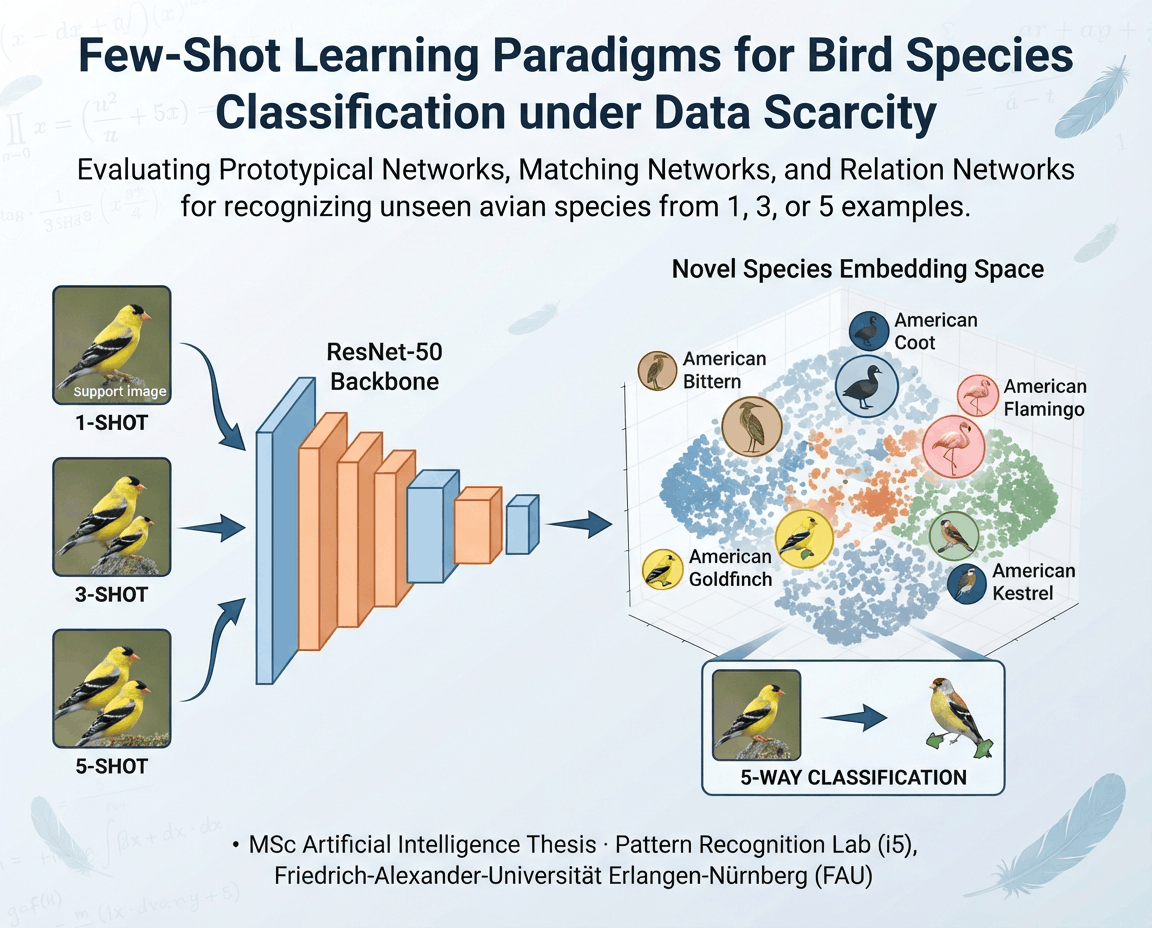
M.Sc. AI thesis at FAU's Pattern Recognition Lab: a controlled comparison of few-shot learning paradigms for recognising unseen bird species from just 1, 3 or 5 images.
Links
Problem
Rare bird species often have only a handful of labelled photos, far too few for standard supervised training. The question: can few-shot learning recognise species a model has never seen from just 1, 3 or 5 examples, and which approach works best when compared fairly?
Solution
Built a config-driven PyTorch pipeline for 5-way K-shot evaluation that compares Prototypical, Matching and Relation Networks against a nearest-centroid baseline and supervised upper bounds, all under identical backbones and protocol.
- Strict base/novel class splits with an automated leakage check
- Episodic training and 600-episode evaluation with Wilson confidence intervals, macro-F1, per-class accuracy and t-SNE embedding analysis
- Extended from Birds-20 to the fine-grained CUB-200-2011 benchmark, and from ResNet-50 to a DeiT-S Vision Transformer
- Experiments run as SLURM jobs on FAU's HPC GPU cluster
- Results published in an interactive Streamlit dashboard
Results
- Prototypical Networks reached 94.1% (1-shot) and 99.8% (5-shot) on unseen species, on par with a fully supervised model
- On fine-grained CUB-200, a simple nearest-centroid classifier on a frozen backbone beat every episodically trained method
- Swapping ResNet-50 for DeiT-S gave the largest single gain (up to +8.7 pp at 1-shot)
- Matching and Relation Networks trailed prototype-based methods by 15–33 pp
Impact
- Evidence that representation quality matters more than the meta-learning algorithm under data scarcity
- A reproducible, open-source benchmark with a public results dashboard
Tech Stack
Python, PyTorch, torchvision, timm, scikit-learn, NumPy, pandas, Matplotlib, Seaborn, Plotly, Streamlit, SLURM (HPC GPU cluster).
Related projects
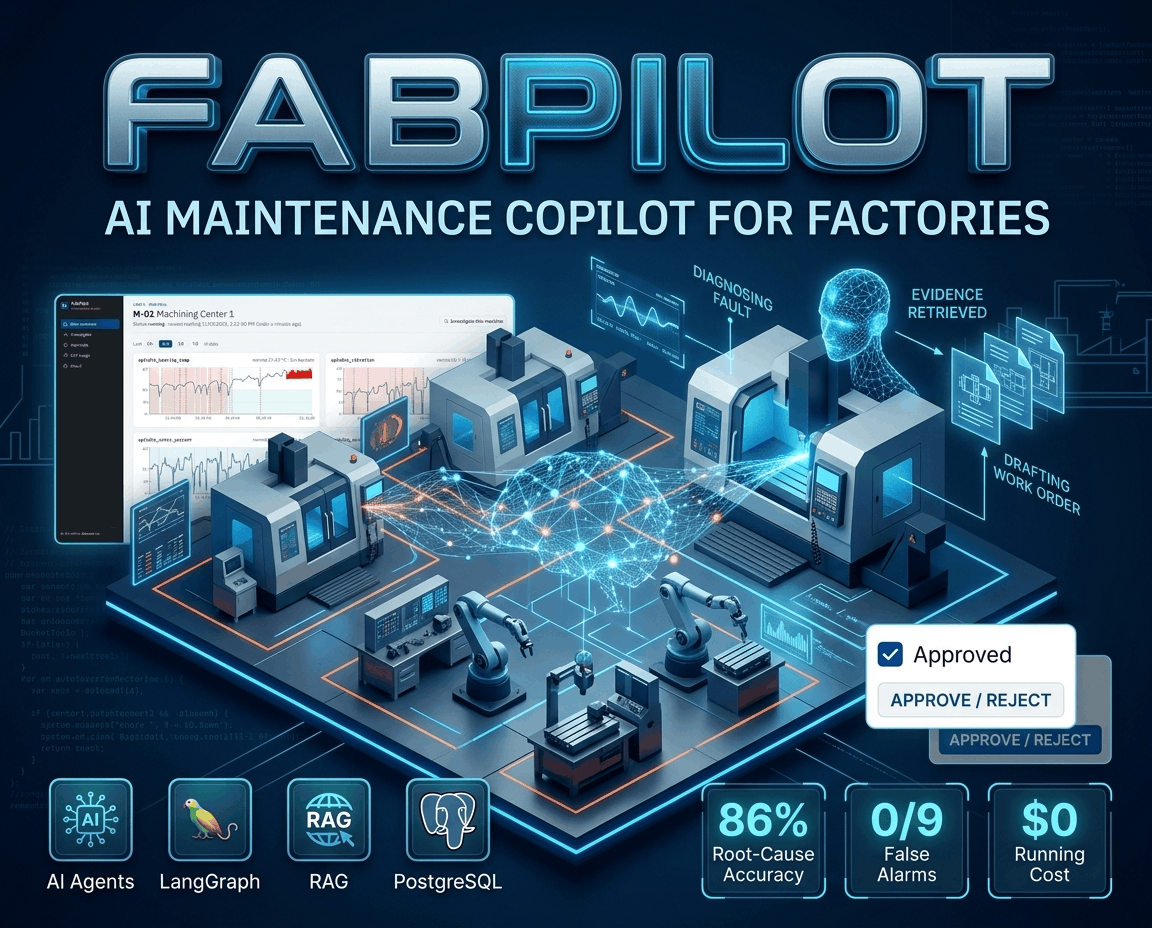
AI agent that diagnoses machine faults from sensor data and maintenance manuals, cites its evidence, and drafts work orders that a person approves.
Real-time emotion detection pipeline with CNN/DNN models using Python, Flask, and React.

Full-stack AI resume analyzer that scores ATS compatibility, detects skill gaps, matches keywords semantically, and rewrites experience bullets using a local NLP pipeline and cloud LLM.